
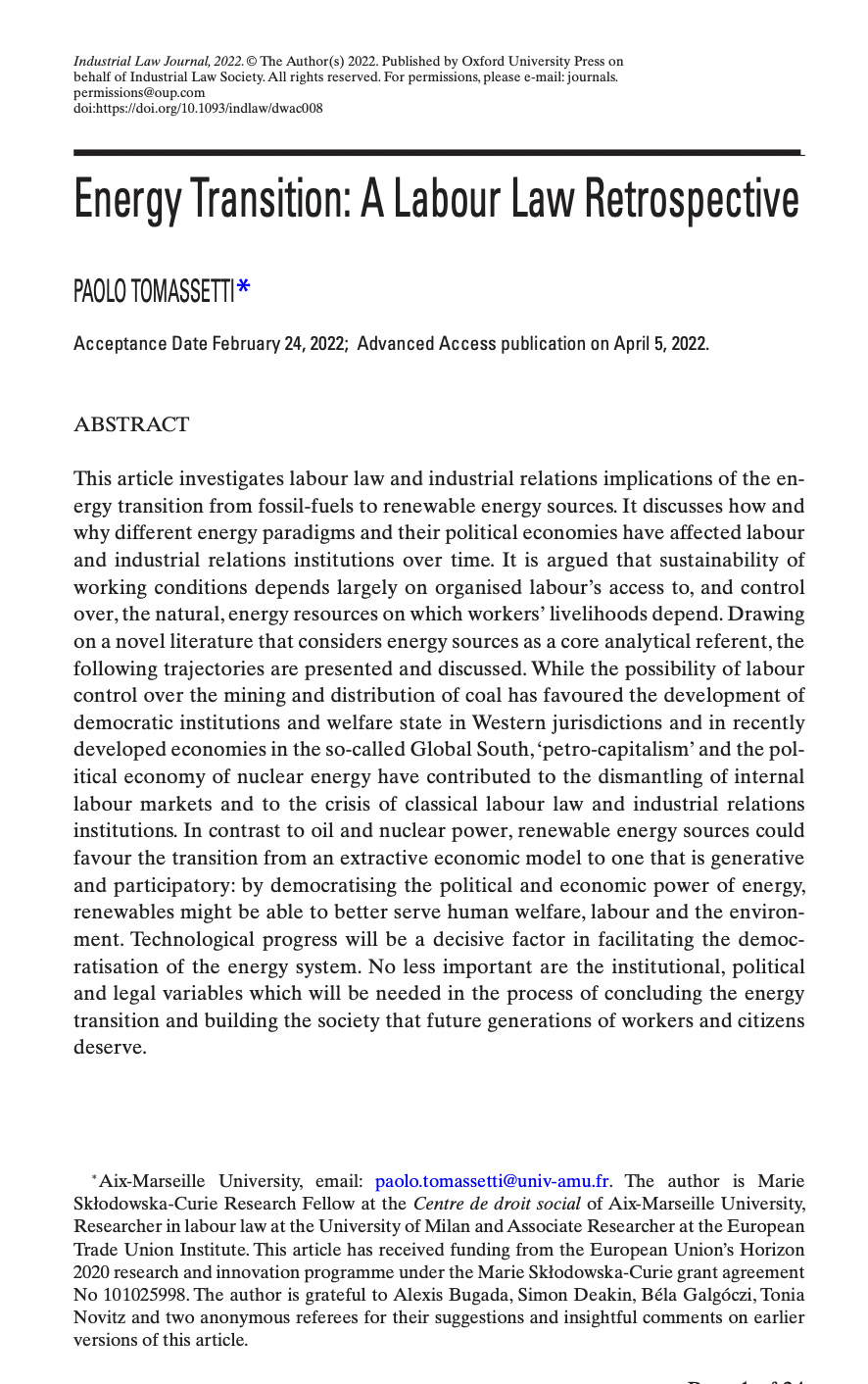
Energy Transition: A Labour Law Retrospective (Industrial Law Journal)
This article discusses how and why different energy paradigms and their political economies have affected labour and industrial relations institutions over time. Drawing on a novel literature that considers energy sources as a core analytical referent, the following trajectories are presented and discussed. While the possibility of labour control over the mining and distribution of coal has favoured the development of democratic institutions and welfare state in Western jurisdictions and in recently developed economies in the so-called Global South, ‘petro-capitalism’ and the political economy of nuclear energy have contributed to the dismantling of internal labour markets and to the crisis of classical labour law and industrial relations institutions. In contrast to oil and nuclear power, renewable energy sources could favour the transition from an extractive economic model to one that is generative and participatory: by democratising the political and economic power of energy, renewables might be able to better serve human welfare, labour and the environment.
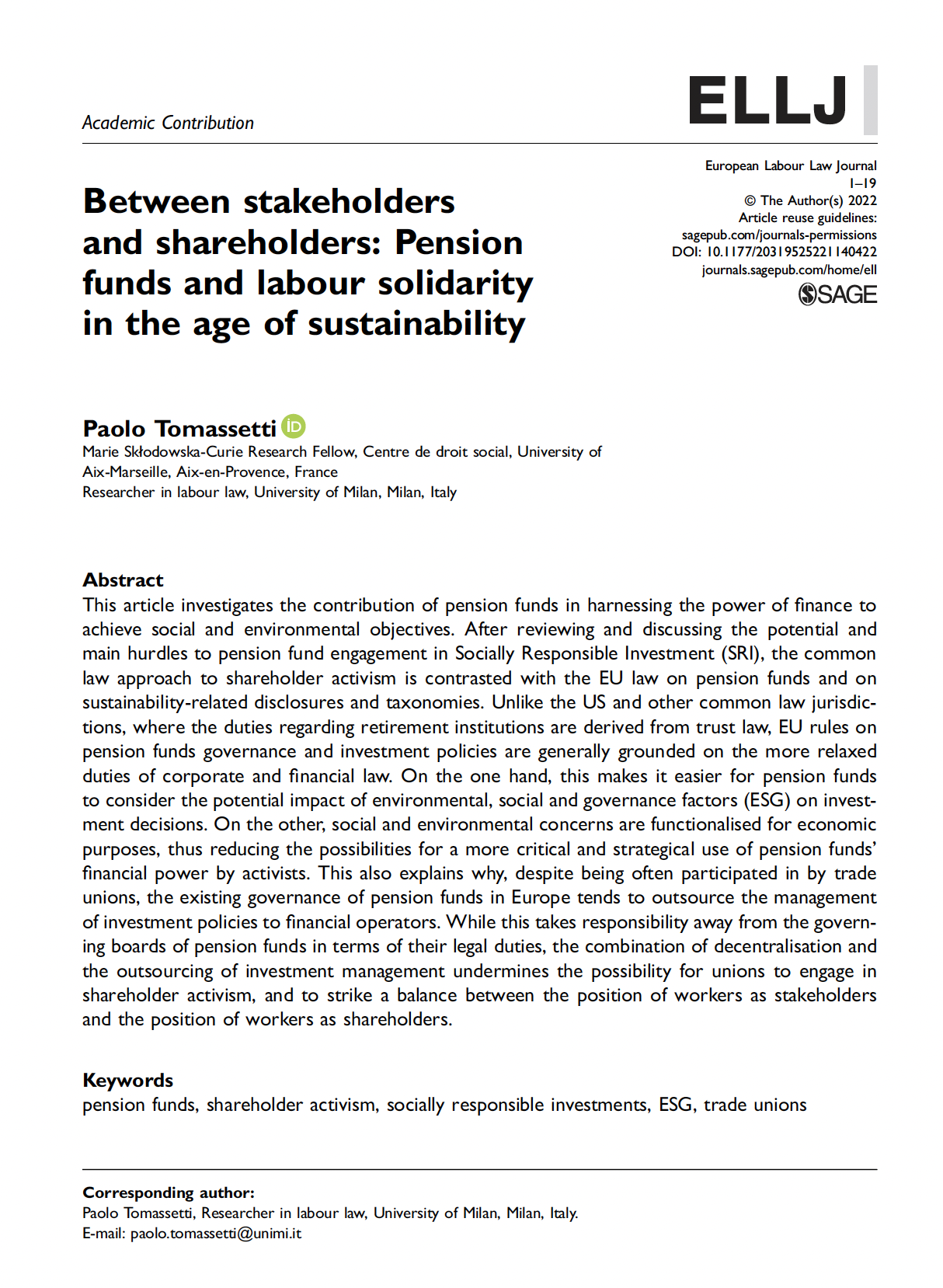
Between stakeholders and shareholders: Pension funds and labour solidarity in the age of sustainability (European Labour Law Journal)
This article investigates the contribution of pension funds in harnessing the power of finance to achieve social and environmental objectives. After reviewing and discussing the potential and main hurdles to pension fund engagement in Socially Responsible Investment (SRI), the common law approach to shareholder activism is contrasted with the EU law on pension funds and on sustainability-related disclosures and taxonomies. Unlike the US and other common law jurisdictions, where the duties regarding retirement institutions are derived from trust law, EU rules on pension funds governance and investment policies are generally grounded on the more relaxed duties of corporate and financial law. On the one hand, this makes it easier for pension funds to consider the potential impact of environmental, social and governance factors (ESG) on investment decisions. On the other, social and environmental concerns are functionalised for economic purposes, thus reducing the possibilities for a more critical and strategical use of pension funds’ financial power by activists. This also explains why, despite being often participated in by trade unions, the existing governance of pension funds in Europe tends to outsource the management of investment policies to financial operators. While this takes responsibility away from the governing boards of pension funds in terms of their legal duties, the combination of decentralisation and the outsourcing of investment management undermines the possibility for unions to engage in shareholder activism, and to strike a balance between the position of workers as stakeholders and the position of workers as shareholders.
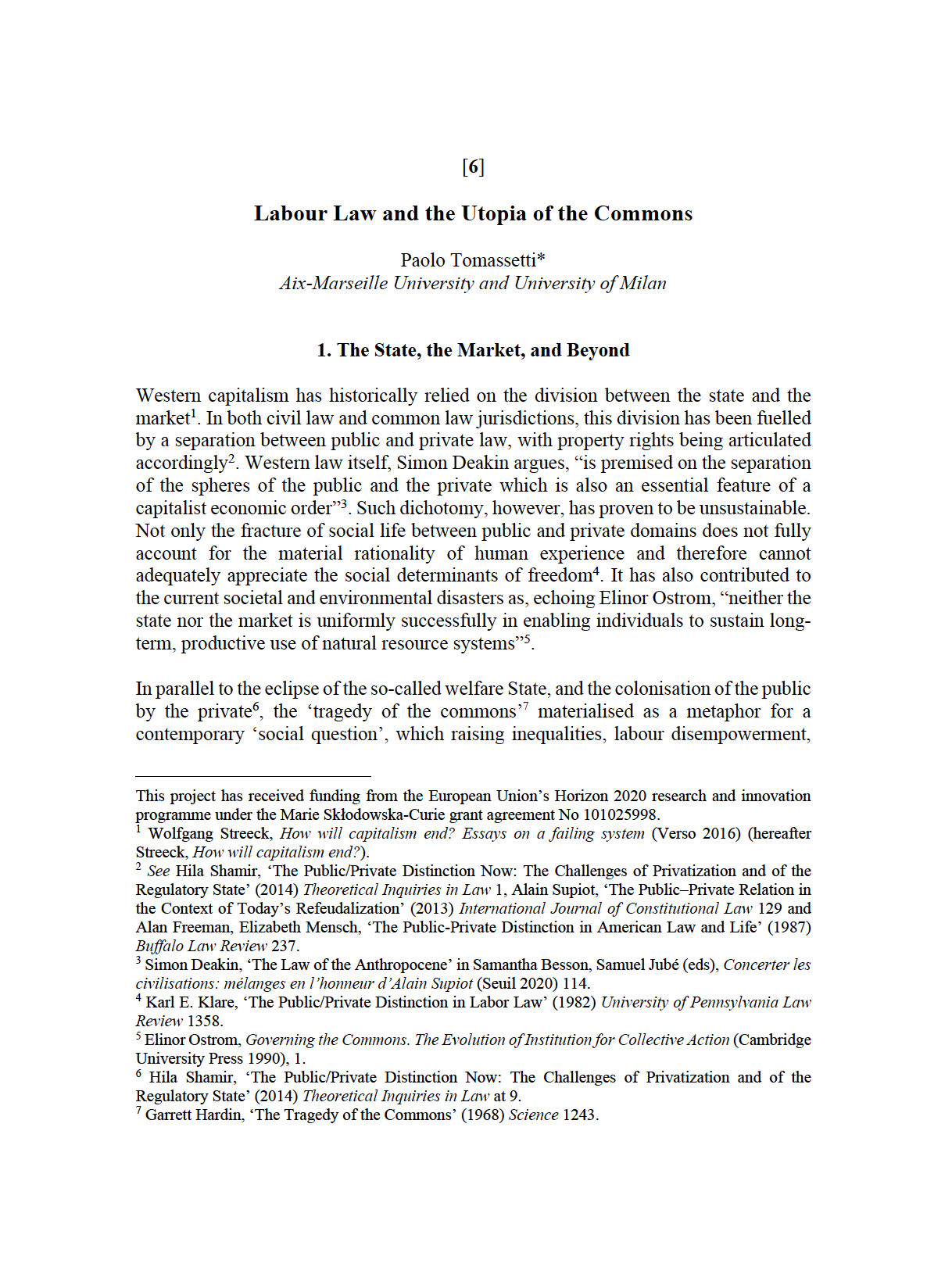
Labour Law and the Utopia of the Commons (Draft)
This paper theoretically discusses the implications of the commons’ theory and practice for labour law and industrial relations. After contextualising the utopia of the commons, and presenting collaborative commons as socio-legal institutions, this chapter contrasts their characteristics with the main common features of labour law and industrial relations frames of reference. Drawing on legal and socio-legal literature on the commons, three broad claims are made and discussed in the following sections. Firstly, classical labour law justifications and industrial relations frames of reference, based on the pluralistic assumption of a conflict of interest between capital and labour, are unfit to frame the idea of work in collaborative commons. Secondly, the ideal-typical function of the commons, that sees the corporation as a commons, is theoretically useful for many purposes. Yet it lacks analytical capacity when it comes to assess the structure of the employment relationship in the capitalistic corporation, which remains unchanged in contrast to the traditional shareholder conception of the firm. Thirdly, and most importantly, it is argued that although there is little scope for classical labour law to land in the non-place of the ‘common good’, the labour movement can learn a lot from the idea of work in collaborative commons. The commons, in fact, offer the possibility to rethink and question some of the basic assumptions of labour law and industrial relations institutions, to reflect on the role that these disciplines can play to close the existing gap between the kind of society we have, and the kind of society that current and future generations of workers might deserve.

From a Siloed Regulation to a Holistic Approach?Labour and Environmental Sustainability under EU Law (Italian Law Journal)
Drawing on a progressive interpretation of the principle of sustainable development, this article reviews, compares and analyses the channels for interaction and integration between labour and environmental sustainability in two EU normative domains: social policy and environment policy. While a siloed approach is still evident in both domains, with few exceptions, recent EU legislation on the economic pillar of sustainability has promoted horizontal policies on labour and environment. Social and environmental clauses have been enacted in EU financial law and public procurement law. The same goes for corporate law when the proposal for a directive on due diligence of multinational companies is adopted. The analysed examples of horizontal policies to advance labour and environmental sustainability present risks and opportunities. Arguably, the main risk is that such policies end up in accentuating rather than overcoming the competition between labour and the environment as “fictitious commodities”.